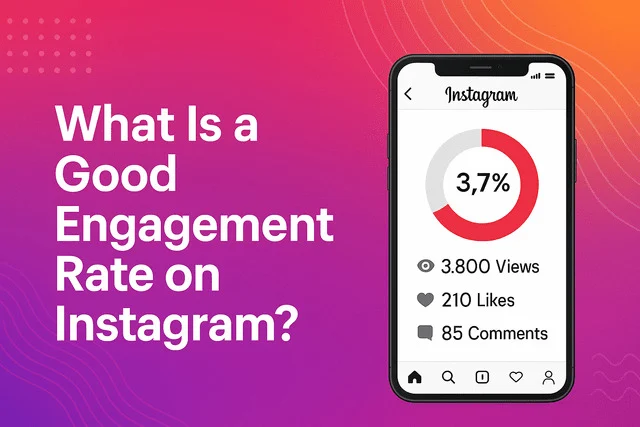
If you use Instagram to grow a brand, promote products, or build an audience, your engagement rate can help you understand whether people are responding to your content. But what percentage should you aim for in 2026?
As a practical starting point, an engagement rate of 1% to 3% can be a reasonable target when calculated using followers as the denominator, while 3% to 5% or higher can be a strong result for many accounts. These are broad planning guidelines, not universal industry averages. Some smaller or highly engaged communities perform considerably better, while large brand accounts may record lower rates.
The most important step is to compare the same formula, content format, and audience type before deciding whether your results are good.
What Is Considered a Good Instagram Engagement Rate?
Instagram engagement rate measures how much people interact with your content relative to a chosen audience or exposure metric. Depending on the formula, the denominator may be your follower count, the number of accounts reached, or impressions.
Engagement can include likes, comments, saves, and shares. Some reports use a narrower set of interactions, so you should always check which actions are included.
Below 1%
May indicate an opportunity to improve content relevance, distribution, or audience quality. It is not automatically poor performance for a large account or a specialized format.
1%–3%
A useful initial target range for many accounts using a follower-based calculation. Compare it with your industry and previous results.
3%–5%
Often a strong result for an account using a consistent follower-based formula, especially when engagement comes from relevant people.
Above 5%
Can be excellent, particularly for a smaller, active community. Check the sample size, content format, and calculation method before drawing conclusions.
For additional context, Sprout Social’s 2026 engagement guidance cites a 0.36% median across industries using its brand benchmark source. Buffer’s benchmark page reports a 4.3% median for its analyzed Instagram posts. These figures differ because datasets, account types, and measurement methods are not necessarily the same.
Sources: Sprout Social’s Instagram engagement rate guide and Buffer’s Instagram benchmarks.
Instagram Engagement Rate Benchmarks for 2026
There is no single engagement rate that applies to every Instagram account. The following comparison shows why it is important to identify the benchmark source and formula before setting a target.
| Benchmark source | Reported figure | How to interpret it |
|---|---|---|
| Sprout Social / Rival IQ brand benchmark | 0.36% median across industries | A brand-focused comparison, not a universal target for every creator. |
| Buffer Instagram benchmarks | 4.3% median engagement rate | Based on Buffer’s aggregated Instagram post data and its engagement methodology. |
| Social Media Loyalty, 2026 study | 3.35% median across its sample | Based on 9,445 public accounts and a formula using average likes and comments divided by followers. |
Sources: Sprout Social, Buffer, and Social Media Loyalty.
Why are the numbers so different?
- Different formulas: Some studies use followers, while others use impressions or reach.
- Different interactions: A report might count likes and comments, while another also includes saves and shares.
- Different account samples: Creator accounts, small businesses, and large brands do not necessarily perform alike.
- Different content formats: A Reel, a carousel, and a static image can attract different kinds of engagement.
- Different statistics: A mean can be influenced by unusually high-performing posts, whereas a median describes the midpoint of a sample.
For your own account, use these reports as context rather than treating one published percentage as a pass-or-fail score. A consistent improvement over your own historical performance may be more useful than matching an unrelated industry average.
What Is a Good Engagement Rate by Follower Count?
Follower count can influence engagement rate. Smaller accounts often have closer relationships with their audiences, while larger accounts may reach many people who interact less frequently.
The following figures come from OwlStat’s October 2026 benchmark study of 22,646 public Instagram accounts. Its methodology calculates engagement using average likes and comments from recent posts divided by follower count. These are study-specific medians, not guaranteed results for all Instagram users.
| Follower count | Reported median engagement rate | Practical takeaway |
|---|---|---|
| 100–1,000 | 4.69% | Smaller communities can generate a high level of interaction relative to their size. |
| 1,000–10,000 | 1.38% | Evaluate both engagement and the relevance of new followers. |
| 10,000–50,000 | 0.68% | Look for repeatable content formats and strong audience fit. |
| 50,000–100,000 | 0.57% | Use consistent comparisons across posts and campaigns. |
| 100,000–500,000 | 0.59% | Assess the quality and business value of interactions, not just the rate. |
| 500,000–1 million | 0.52% | A relatively small percentage can still represent substantial interaction volume. |
| More than 1 million | 0.62% | Measure reach, relevant engagement, and conversions alongside the rate. |
Source: OwlStat’s Instagram engagement benchmarks for 2026.
Does a larger Instagram account always have a lower engagement rate?
No. There is a general tendency for engagement percentages to decrease as audiences grow, but it is not a strict rule. A large account with a well-defined audience can outperform similar accounts, while a smaller account with inactive followers can struggle.
Use follower count to select relevant comparisons, not to excuse weak content or assume that a particular result is inevitable.
How to Calculate Instagram Engagement Rate
Before calculating engagement, choose the denominator that matches your goal. Two of the most useful methods are engagement rate by followers and engagement rate by reach.
1. Engagement rate by followers
Engagement rate = (Total interactions ÷ Followers) × 100
Use this method when you want to compare interaction volume with your existing audience size. It is also common in influencer and public-profile benchmarking.
Example: Your Instagram account has 8,000 followers and one post receives 240 interactions.
(240 ÷ 8,000) × 100 = 3%
Your follower-based engagement rate for that post is 3% using the interactions included in your calculation.
2. Engagement rate by reach
Engagement rate by reach = (Total interactions ÷ Accounts reached) × 100
This method compares interactions with the unique accounts reached. It can be particularly useful when evaluating individual posts or understanding how effectively content encourages responses from the people who see it.
Example: Your post receives 240 interactions and reaches 4,000 accounts.
(240 ÷ 4,000) × 100 = 6%
The engagement rate by reach is 6%, which is different from the 3% follower-based rate in the previous example.
3. Engagement rate by impressions
Engagement rate by impressions = (Total interactions ÷ Impressions) × 100
Where impressions are available and consistently defined, this formula compares interactions with total content displays. Because the same person may encounter content multiple times, impressions and reach should not be treated as interchangeable.
Which formula should you use?
| Your goal | Suggested measurement |
|---|---|
| Benchmark an influencer’s public account | Follower-based rate using a clearly defined interaction set. |
| Evaluate a specific post | Engagement rate by reach, if reach is available. |
| Compare repeated content exposure | Impression-based rate, where consistently reported. |
| Measure business outcomes | Engagement alongside tracked leads, conversions, and revenue. |
Free Instagram Engagement Rate Calculator
Enter your follower count and the interactions on a post to calculate your engagement rate. You can also switch to reach-based measurement if you know how many accounts saw the content.
Enter your numbers and select Calculate Engagement Rate.
The calculator counts likes, comments, saves, and shares. Instagram reports and external benchmark studies may define engagement differently, so use the same interaction set when making comparisons.
How to interpret your result
- Compare like with like: Use the same formula for every post in your comparison.
- Review several posts: One viral post may not represent your usual performance.
- Consider content goals: A post designed to generate sales may need a different success measure from an entertainment Reel.
- Track the trend: Improving from your own baseline can be meaningful even if you are below an external benchmark.
Instagram Engagement Rates by Content Type
Different formats create different opportunities for interaction. A Reel may reach new viewers, a carousel may encourage saves, and a Story may lead to replies or other direct responses.
Instagram Reels
Reels can help content reach people who do not already follow an account. To evaluate them, look beyond likes and review available reach, views, shares, saves, comments, and watch-time metrics.
A Reel can have substantial reach but a modest follower-based engagement rate. That does not necessarily mean it failed: it may have introduced your account to a new audience.
Instagram carousels
Carousels are useful for tutorials, checklists, comparisons, and step-by-step explanations. Saves and shares may be particularly relevant when the goal is to create content people want to revisit or recommend.
Single-image posts
Static posts can still perform well when the visual is compelling and the subject matters to your audience. Compare them with similar posts rather than assuming that one format must always outperform another.
Instagram Stories
Stories can support ongoing relationships with existing followers. Replies, poll responses, link-related actions where available, and other interactions may be more relevant than a conventional feed-post engagement rate.
Does Engagement Rate Affect Instagram’s Algorithm?
Engagement is one useful signal of how audiences respond to content, but there is no single public engagement-rate threshold that guarantees wider distribution.
Instagram uses different ranking systems across surfaces, including Feed, Stories, Explore, and Reels. The factors that influence what people see can vary by surface and context. A high engagement rate should not be interpreted as a promise that a post will go viral.
Instead, focus on creating content that satisfies the audience’s needs, encourages meaningful interactions, and performs well against your own objectives. For platform-specific guidance, consult the Instagram ranking explanation and the Instagram Help Center.
How to Increase Your Instagram Engagement Rate in 2026
Improving engagement usually requires better audience fit, stronger content, and consistent measurement rather than a single trick. These strategies provide a practical starting point.
1. Create content for a specific audience
Identify the questions, interests, and problems your intended audience cares about. A post that addresses a specific need can be more relevant than a generic update designed to appeal to everyone.
2. Strengthen the opening
Make the subject and benefit clear early in a Reel or caption. Use an informative headline, an interesting demonstration, or a direct statement that gives viewers a reason to continue.
3. Give people a reason to save or share
Publish useful checklists, original insights, tutorials, comparisons, and reference material. Do not ask for saves or shares without giving people a genuine reason to take those actions.
4. Encourage meaningful conversation
Ask relevant questions and respond to comments that deserve a reply. Focus on genuine discussions rather than engagement bait or repetitive comments that add little value.
5. Use Insights to find winning topics
Review a group of recent posts and identify which subjects repeatedly generate relevant interactions. Reuse successful ideas in new formats without copying the same post repeatedly.
6. Publish consistently
Choose a schedule you can maintain while preserving quality. Consistency makes it easier to collect comparable data and understand what works for your audience.
7. Test your publishing times
Use available audience activity data as a starting point, then test different publishing windows. Do not assume a universal best time applies to every account or time zone.
8. Attract relevant followers
Follower quality matters. A smaller audience interested in your niche may generate more meaningful responses than a larger audience with little connection to your content.
9. Avoid buying followers or engagement
Purchased followers and artificial engagement can distort your analytics and provide little real value. Focus on attracting people who genuinely care about your content, brand, or products.
10. Review results every month
Track your engagement rate alongside reach, follower growth, profile activity, and business outcomes where relevant. Monthly reviews can help distinguish repeatable improvements from short-term fluctuations.
How to Set a Realistic Instagram Engagement Goal
Rather than chasing a universal percentage, build a target based on your own account and the people you want to reach.
- Establish a baseline: Calculate engagement for a representative group of recent posts using one consistent formula.
- Segment your content: Separate Reels, carousels, images, and campaigns where appropriate.
- Choose a realistic improvement: Aim to improve on your baseline instead of immediately matching a benchmark from a different dataset.
- Measure interaction quality: Review relevant comments, saves, shares, and audience fit.
- Connect engagement to outcomes: For a business account, also track inquiries, leads, sales, or other meaningful results.
- Review and adjust: Reassess your goal as your audience grows and your content strategy changes.
For creators and smaller businesses, a steady improvement in relevant engagement may be more valuable than achieving an unusually high percentage on one post.
Frequently Asked Questions
Is a 2% engagement rate good on Instagram?
A 2% rate can be a good result, particularly when calculated consistently against followers and compared with similar accounts. Its meaning depends on your industry, audience size, content type, and formula.
Is a 3% engagement rate good on Instagram in 2026?
A 3% rate is a reasonable result under many follower-based measurement approaches. Check how the rate was calculated and compare it with accounts in your niche before deciding whether it is above average.
Is a 5% engagement rate good on Instagram?
Yes, 5% can be a strong result, especially for an account with a relevant and active audience. Make sure you are not comparing a reach-based rate with a follower-based benchmark.
Is a 10% Instagram engagement rate good?
A 10% rate is high under many common measurement approaches. It may occur with smaller communities or particularly successful posts. Verify the formula, sample size, and interaction quality before generalizing from the result.
What is the average Instagram engagement rate in 2026?
Published studies report different figures because they use different samples and formulas. For example, Buffer reports a 4.3% median in its Instagram benchmark data, while Sprout Social cites a 0.36% cross-industry median from a brand benchmark source. These figures should not be treated as directly interchangeable.
Do smaller Instagram accounts get higher engagement?
Smaller accounts can achieve higher engagement percentages because they may have closer relationships with their audiences. However, this is a tendency rather than a guarantee. Audience relevance and content quality still matter.
Should I calculate engagement rate by followers or reach?
Use a follower-based rate for audience-relative comparisons and a reach-based rate to evaluate interactions among the accounts reached by a post. Choose the formula that fits your goal and keep it consistent.
Do likes, comments, saves, and shares all count as engagement?
They are commonly included in engagement calculations, but the exact interaction set depends on the reporting tool or benchmark study. State which interactions you count so your results remain comparable.
Does a high engagement rate guarantee more reach?
No. Engagement is not a guarantee of distribution. Instagram’s ranking systems use multiple signals, and the factors can differ across Feed, Stories, Explore, and Reels.
How often should I calculate my Instagram engagement rate?
Calculate it regularly, such as weekly or monthly, depending on how frequently you publish. Use a representative set of comparable posts to avoid overreacting to one unusually successful or unsuccessful result.
Final Verdict: What Is a Good Instagram Engagement Rate in 2026?
For many accounts, a follower-based engagement rate of 1% to 3% is a useful starting target, while 3% to 5% or higher can indicate strong interaction. However, these ranges are guidelines, not official Instagram standards.
Your account size, niche, content format, audience quality, and calculation method all affect what counts as good performance. Public benchmark studies can help you understand the broader landscape, but they should only be compared when their methodologies are sufficiently similar.
Calculate your engagement rate consistently, analyze which posts create meaningful responses, and track improvements over time. The best engagement rate is one that reflects a real connection with your audience and supports your wider goals.